Showing posts with label ASSM. Show all posts

2024 Year In Review

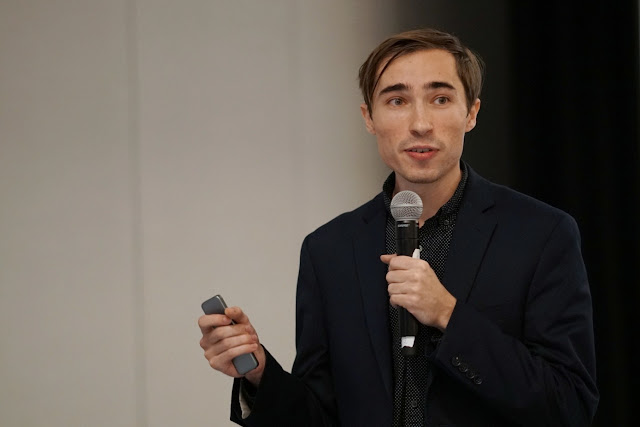
Teachers leading PD in the San Luis Valley

Where did the year go? In order to get at least one post up on this blog before the calendar flips to 2025, let me recap some big events of the last year.

January 2024: Math Routines in the San Luis Valley

The first highlight of the past year happened in Alamosa in January, and it was the result of many months of work. In Summer of 2023, my CDE colleagues and I recruited a dozen teachers from Colorado's San Luis Valley to attend conferences in Denver for four days and then turn what they learned into local professional development for districts in the San Luis Valley in January. I'm skipping over a lot of details, but it was great to work with these teachers and support them in their sessions.

February 2024: Launch Years Convening in Anaheim

It was a great year working with Colorado's Math Pathways Task Force and receiving support through the Launch Years Initiative. A contingent from Colorado joined up with more than 20 other states in a very rainy Anaheim, California to share progress and strategies about how to improve high school math and transitions for students as they matriculate to college and other postsecondary opportunities.


It rains in California, sometimes

July 2024: Math Intervention Design Workshop

In July, CDE teamed up with CCTM to host a design workshop in Summit County for a week. As I told the attendees, it probably felt like (a) work that felt like a vacation, or (b) a vacation that required a lot of work. Either way, Summit County in the summer is a delightful place to be. About 20 educators of all kinds -- higher ed, K-12, veterans, novices -- worked to develop materials that should be useful with students who are still struggling after regular instruction. We were all really pleased with the effort that went into these materials and we're looking forward to getting them into people's hands and getting feedback about how well they work.

The design workshop participants got to test their creations with summer school kids in Leadville, who graciously hosted us for a morning

September 2024: ASSM, NCSM, and NCTM in Chicago

This year's ASSM, NCSM, and NCTM conferences were in Chicago. To take in all three conferences requires a 9-day stay and by the time it's over, my head is swimming with all sorts of ideas and things I want to do and learn more about. ASSM held their conference in a hotel on Navy Pier, which was a treat.

In recent years, I've tried to blog at the end of each day of my conference trips. That didn't happen this year -- I was more social in the evenings than usual, with takes time, and I had two presentations at NCTM to finish preparing for. I kept thinking I'd get around to writing some recaps, but maybe I'll settle for a few bullet points here:

  • A decade ago, I joked with many people that if you wanted people to show up at your session, all you needed to do was name it something like, "Common Core iPad Games for the Flipped Classroom." I don't know what would get the equivalent amount of attention today, but surely it has "AI" in the title. I've seen a few AI presentations so far and I'm still waiting for one that (a) focuses on the use of AI in math education specifically and (b) is practical without too much hype / too little skepticism.
  • There's a national momentum for reforming high school math. I don't know exactly what the results of that momentum will bring, but I hope it's great. What we currently have isn't serving enough of our students as well as it should.
  • I used to read stories about how many baby boomer teachers would be retiring. I think we're on the other side of that now, and it feels like we have a lot of younger and more novice teachers who can really benefit from the support they get at conferences and in their other professional learning. I know what teachers can get out of a 60- or 90-minute conference session is limited, but the overall exposure to new ideas and the enthusiasm behind them is something I hope every teacher has a chance to experience.

Navy Pier, Chicago, is a great place to enjoy a conference

October 2024: Fall Math Pathways Summit

To put an explanation point on Colorado's math pathways work, the task force hosted a summit in Colorado Springs. About 100 people attended from all over, and there's a lot of excitement about the work.

Thanks to Pikes Peak State College for providing a great space for the Fall Math Pathways Summit


So Long, D.C.: ASSM Annual Meeting Day 4

Diana Suddreth

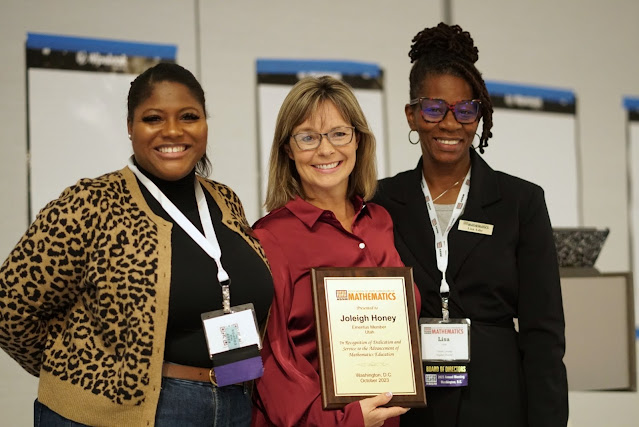
Today was a quick half-day to wrap up the ASSM Annual Meeting. We began with another portion of our business meeting where we honored Joleigh Honey as she achieved emeritus status, recognized the work of ASSMs many committees and interest groups, and previewed some of ASSM's works in progress. That transitioned nicely to a half hour looking at the work of our assessment SIG, led by Andy Byerley and Mary Pittman.

Eboney McKinney, Joleigh Honey, and Lisa Ashe

We then got over an hour to spend with Nafeesa Owens from the White House Office of Science and Technology Policy. Although it seems like the White House OSTP just updated our national STEM strategic plan, that was 2018 and the White House tries to update this plan every 5 years. The OSTP is organizing itself around a 5-part framework that includes STEM education, STEM engagement, STEM research and innovation, STEM workforce issues, and STEM workforce development. Nafeesa very patiently listened to a whole host of concerns and suggestions across a wide range of STEM-related issues.

Nafeesa Owens

We wrapped up our meeting with the end of the business meeting. This included details about next year's meeting in Chicago, recognizing members leaving the board, and acknowledging those who are either starting or continuing their service as board members.

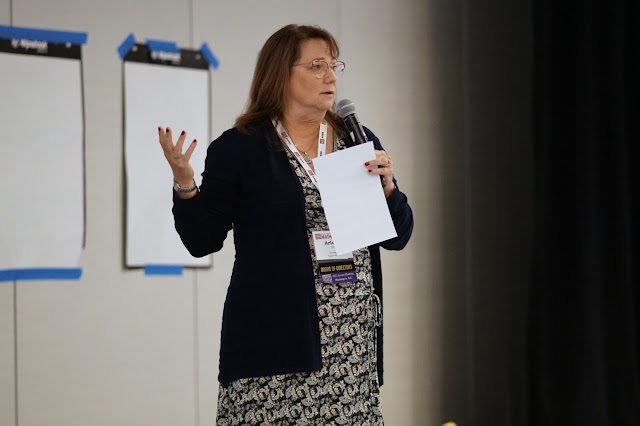
Arlene Crum

2022-2023 Board of Directors

2023-2024 Board of Directors


A Packed Day: ASSM Annual Meeting Day 3

Today was the 3rd day of ASSM and 6th day of travel overall. Despite having done a ton today, I'm going to keep these notes as short as I can so I can get some rest before the last day of ASSM tomorrow and heading back to Colorado.

Fun and Games

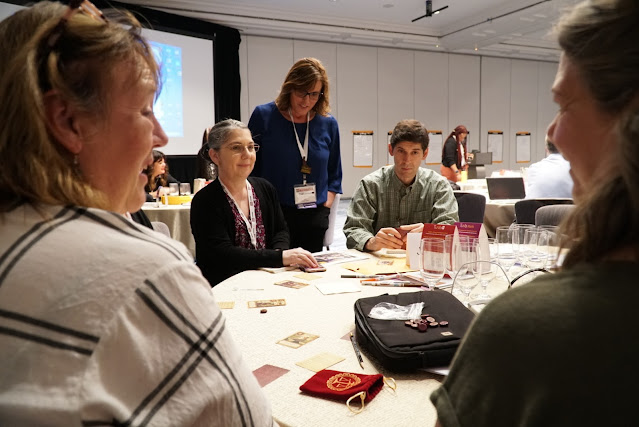
We kicked off the morning with math tasks and games. It wasn't a lot of time, but generally enough that people got to try two or three tasks if they wanted.

Gideon Hertz

Next, we got some advice about communications strategies from Gideon Hertz of Burness Group. It's always good to get some pointers on effective communication in our roles as state employees.

Anthony Purcell

We spent about a half hour back in our breakout groups for standards and high-quality teaching, but this time we focused our conversations on communication as a way of tying it to the previous session.

Charles Steinhorn

In our final session of the morning, we heard from Charles Steinhorn, Director of the Conference Board of Mathematical Sciences. If you've never heard of CBMS, they're the umbrella organization that brings together almost every math and math education organization you're probably familiar with.

John SanGiovanni

Much of the afternoon was focused on elementary mathematics, specifically fluency. John SanGiovanni spent an hour helping us understand his 10 "big ideas" for figuring out fluency, such as "fluency isn't basic" and "strategies are for each and every student."

Jennifer Bay-Williams

Following John, Jennifer Bay-Williams talked to us about going beyond accuracy and ways we can assess procedural fluency. There are ways of explicitly teaching strategies without resorting to direct instruction, and ways for students to know facts from memory without relying on memorization to know the facts.

Zarek Drazda

Our last session of the day featured Zarek Drazda of Data Science 4 Everyone. We live in a world with an enormous amount of data and data will drive work and wealth in this century the same way property and physical resources drove work and wealth the past few centuries. K-12 data science education is a rapidly developing field and new projects, new courses, new curricula, new legislation, and new professional development are popping up all the time.

Carrying the Torch
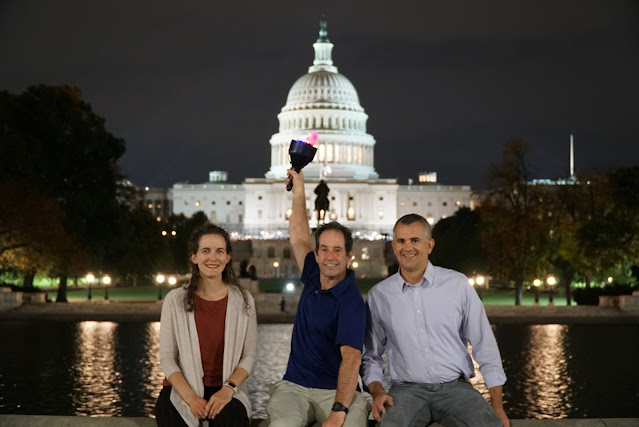
I met my CDE colleagues for dinner. They're in town to attend the NCSM Conference and we swapped notes and stories while we ate. After dinner, we headed to the National Mall and took some pictures in front of the Capitol. Members of our office are taking turns taking a plastic torch around with us in preparation for an Olympic-like theme for an event next summer. And then it rained, which definitely wasn't part of our plan.

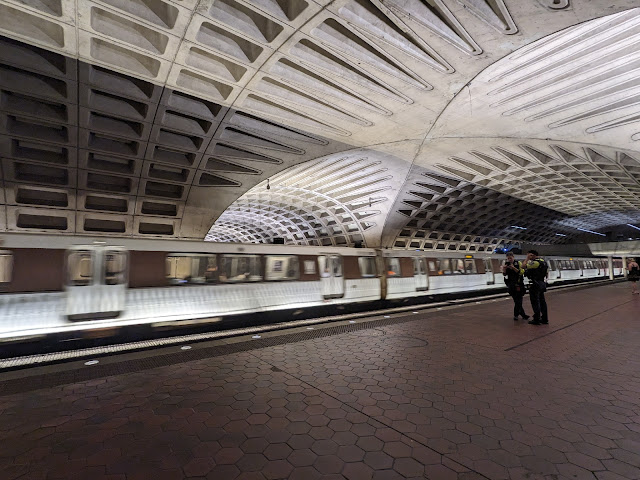
L'Enfant Plaza
I've gotten around D.C. now for a week using nothing but the Washington Metro train system and my own two feet. ,For a Midwest country boy like myself, I find big city public transportation to be a great use of public dollars and well-worth using by an out-of-towner. $58 for a week-long pass to go anywhere in the system can't be beat.

An Organizational Perspective: ASSM Day 4, Costa Mesa

The 2021-2022 ASSM Board of Directors

The final day of the Annual Meeting of the Association of State Supervisors of Mathematics was a short one, with two sessions of board business and two big presentations. We finished at noon to give people time to travel home or get to NCSM, if they hadn't left already.

Mike Steele

President Joleigh Honey led us through the first business meeting portion before handing things over to Mike Steele, who presented a session to get us thinking about how we can leverage state systems to help modernize mathematics learning opportunities for students. In a twist, he used some deficit framing to start his talk, and acknowledged doing so to help establish some contrast for the asset-based approaches that we'd be thinking about the rest of the session. There was some thought-provoking ways in which standards are positioned in the work that we do as state supervisors of mathematics, and I'm eager to go back to his slides and references and dig into that a little deeper.

Kyndall Brown

Our final presentation was by Kyndall Brown, the executive director of the California Mathematics Project. California is a large state with multiple layers to its school support networks, and there are many ways these work with their NCTM affiliate, CMC (which itself has multiple parts and events), and other organizations to improve math teaching and learning statewide. Sometimes the efforts are at a high policy level, such as the state math frameworks, and sometimes they operate on a small, local level, like a scaled-up lesson study project that takes the experience of single students as its focal point. Few of us have the size or number of resources as California, but all of us have some people and some organizational assets ("organizational assets" was the conference theme of the day) that can operate on a similar, if not scaled-down, fashion in our states.

New ASSM President Lisa Ashe

The last bit of business was to thank the outgoing board members and pass leadership of the organization to the new board members, including our new president, Lisa Ashe of North Carolina. As Joleigh mentioned, Lisa has been operating more like a co-president rather than a typical president-elect, so this is going to be a smooth transition. Lisa is also the first African American to be president of ASSM, so it's a wonderful accomplishment for her and a sign of progress for our organization. Lisa's first act was to gavel the meeting closed. See you next year in Washington, D.C.!

Getting Interpersonal: ASSM Day 3, Costa Mesa


Problem solvers solving problems

Today at the ASSM Annual Meeting, we elevated yesterday's theme of personal assets to become a theme of interpersonal assets. We'd get to that soon enough, but first, we started the day with some math. I don't know what it's like in other content areas, but it's seen as good practice to take on a math task or two in any sort of professional development with math teachers and educators, and for the most part, we really enjoy it.

Mary Mooney (WI) and Anne Wallace (NH)

After a break, we transitioned to participating in two Potentials of Practice. This was an opportunity for two members, one in an elementary group and another in a secondary group, to pose an issue that is challenging them while the rest of us listened before participating in a structured discussion to help bring clarity. The secondary group tackled a communication issue while the elementary group (I think, as I wasn't in that group) dealt with negotiating some tensions between teaching practices and assessment practices. It felt like a great example of using our interpersonal assets, as we all share similar challenges yet there's enough diversity across the group that new ideas could come to the surface.

Megan Franke

We stayed in elementary and secondary groups as we moved to breakout sessions, something we used sparingly in this year's program. Both leveraged assets local to the Los Angeles area. Megan Franke of UCLA joined us for a session called "Supporting the Mathematical Brilliance of Young People," in which we watched some amazing examples of student reasoning and learned the results of recent research that involved interviews of almost 500 preschoolers. Some of the key findings: Students are better at counting if there's some purpose to their counting. Researchers assumed that students could count further if asked to simply count out loud than if they were asked to count objects, but the opposite turned out to be true. And when given 8 little plastic bears to count, lined up in a row, the students showed less counting skill than when given 31 pennies to count from a pile. Maybe it shouldn't surprise us at this point, but this feels like another instance where the more authentic the task, the more students seem to shine.

Brian Lawler

In the secondary breakout session, Brian Lawler, Bryan Meyer, and Abi Leaf described their multi-year efforts at high school math reform in a session called, "Designing a System to Provoke Change - in Actions and Beliefs." I've seen them present multiple times before, so I spent more time in Megan's session, but I know they were able to synthesize and reflect on some things and I'm hoping to hear more about what they presented.

Rachel Lambert

The afternoon returned to sharing perspectives about what being an ASSM member means. To some people, it means an awful lot and they seem happy to share it. These moments tend to swing towards the emotional and away from the informational, which doesn't interest me, but not everything at a conference has to be for me. From there, we went right into a session that I think is going to stick with people for a long time. Rachel Lambert presented "Equitable Systems of Mathematics," but it could have been named something like, "Special Education Mathematics Instruction is Broken." Rachel is a great presenter and a straight shooter, and the evidence she presented made it clear that this really isn't a problem inherent in individual educators, either in the regular math classroom or in special education settings. It's really the interaction of many interpersonal and systemic factors, not the least of which is a seemingly incompatible set of theoretical perspectives driving practices on the two sides.

Shannon Olson (UT)

There's just a half day left of this year's ASSM Annual Meeting. It's gone by quickly and I think a lot of that comes from having such a tight program with high-quality sessions. And tomorrow's presenters aren't likely to be any different. Then it's on to Anaheim and NCSM.

Pondering Personal Assets: ASSM Day 2, Costa Mesa

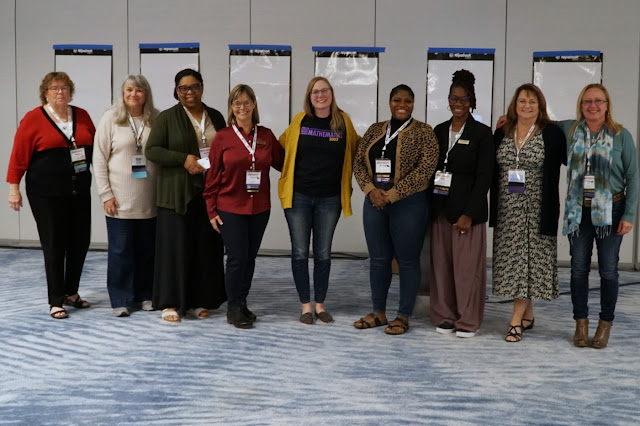
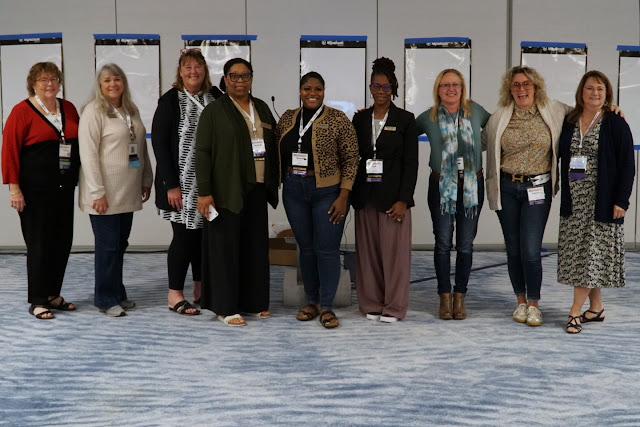
The 2022 ASSM group photo. (Thanks for the photo-taking assist, Ken Krehbiel!)

I was a little skeptical when we the program committee discussed possible themes for this year's ASSM Annual Meeting, mostly because I've been to a lot of good conferences where the theme began and ended with a single line on the cover of the program book. And they were still good conferences! But thankfully, the other members of the program committee were more optimistic than I was, and they came up with a theme that focused on asset-based perspectives. Not only that, but we tried to tweak the theme for each day and have sessions to match. The theme for today was personal assets and we were on track right from the start.

Dr. Patrick Callahan of Math ANEX

Patrick Callahan gave a great session called, "Asset-based Assessments: Design and Systemic Impacts." Honestly, there's some low-hanging fruit here that works great for getting an audience of educators on the same page. The way we assess students -- with standardized and standardized-styled test, especially -- reflect deficit-based perspectives on what students know, or more accurately, don't know. Patrick had some really great examples, one of which was a composite area problem that could be solved by finding the sum of the area of two rectangles. When students get such a problem incorrect, and we don't look any further, we conclude students didn't learn. But when Patrick led us through a study of students' most common wrong answers, you got a much better idea of what students were bringing to the problem. Now, of course, nothing is perfect. Students who leave the answer blank or write "idk" still don't give you much to work with. But students who understand its a composite area problem but make a computational mistake are in a very different place than a student who multiplies all the dimensions together because they know when it comes to areas and rectangles, multiplying the length of the sides is how to get an answer. Along with some other helpful examples, Patrick helped us all think about better ways to use assessment results to focus on what students know, rather than what they don't.

Assistant Secretary Roberto J. Rodriguez

One of the perks of being in ASSM is that we bring in high-ranking people who understand our roles as state-level specialists who bridge the worlds of policy and practice. For this year's meeting, we were joined by Roberto J. Rodriguez, Assistant Secretary of Planning, Evaluation, and Policy Development at the U.S. Department of Education. He covered a number of different national priorities and challenges, such as improving teacher recruiting and retention, the impact of the latest NAEP scores, and how the current culture wars are distracting from the good work that's being done and more good work that needs to be done. ASSM members use these visits to help press the USDOE on some issues, like the need for fresh approaches to accountability post-NCLB and why PAEMST awardees don't get more recognition.

NCSM President Paul Gray

We also received a visit from Trena Wilkerson, the president of NCTM, and Paul Gray, the president of NCSM. We got a sneak peek at an upcoming project that looks to build on the ideas of Catalyzing Change, and you can expect more to be shared as the week progresses and as work gets underway. We also got to see some of the new and upcoming publications coming from NCTM, and heard that they'll be refreshing their advocacy toolkit.

NCTM President Trena Wilkerson

Trena stuck around to deliver a second session, titled "Developing, Strengthening and Supporting Mathematics Instructional Systems Through Asset-Based Approaches." Again, fitting the theme for the day, we had time to listen, learn, and share with other members some of the ways we can recognize and build from the assets students bring to the classroom.

Christine Koerner (OK) and Diana Kasbaum (WI)

Lastly, we also took a few moments throughout the day to conduct ASSM business and reflect on our organization at 60 years old. Diana Kasbaum of Wisconsin shared some of her reflections, and Anne Mikesell of Ohio led an "In Memoriam" moment for a former member who passed last year. There's a timeline on the wall with some artifacts of annual meetings gone by, like copies of some old programs and other materials people gathered from past events. We each added ourselves to the timeline to mark when we each joined, and it's a skewed distribution, as you'd expect. I'm inching towards the veteran group at almost 7 years being a member, but that's a long way from the likes of Steve Leinwand and Cathy Seeley, who've been active for more than 30 years.

Back on the Conference Circuit: ASSM Day 1, Costa Mesa

Do I remember how to do this? Both the traveling and the blogging?
I'm in Costa Mesa, California, for the first in my tripleheader of math education conferences, the Annual Meeting of the Association of State Supervisors of Mathematics. If you're not familiar with ASSM, that's okay. It's a small professional organization only open to people who have a job like mine, or to associate members who used to have a job like mine. For me, ASSM has the highest percentage of friendly faces and the most sympathetic ears of all the conferences I attend.
 
It was a challenging travel day. Security lines at Denver International Airport wrapped around the building, then our plane broke and we had to get a replacement crew. We finally were in the air after a 2.5-hour delay. Then I single-handedly battled California car culture by walking from the airport to the hotel. Navigating away from the airport on foot was a bit tricky and I admit there's not much beauty in walking alongside 10 lanes of traffic, but I'm glad I did it. If nothing else, it's a good way to get in lots of steps and it helped me deal with the carbon on my conscience after a flight.
 
With the delays, I missed the first half of the opening session of the ASSM meeting. When I got there, Steve Leinwand and Cathy Seeley were holding court, sharing stories from their many years of membership in ASSM, and sharing wisdom about what we can get from our time in ASSM and what opportunities we have to pay it forward. ASSM turns 60 this year and I enjoy math ed history, so I hope to hear more tales before the weekend is done.

Notes on the 2016 ASSM Annual Meeting

Prior to getting my new job as Colorado's mathematics specialist, I didn't know there was an Association of State Supervisors of Mathematics (ASSM). Such a group does indeed exist, with almost 200 members, and I joined them for our Annual Meeting in San Francisco in advance of the NCTM Annual Meeting and NCTM/NCSM pre-conferences. You can think of this as a pre-pre-conference, if you'd like, and it consisted of long days in hotel meeting rooms with some pretty good activities and speakers. Here's my rundown with some notes (more photos are here):

Friday, April 8

  1. New Member Orientation (Dewey Gottlieb): It's always important for organizations to make a good impression on new members, and ASSM has the good fortune of having Dewey Gottlieb be the one welcoming me and the other new members this year.
  2. PAEMST Coordinator Meeting (Diana Kasbaum): One of the duties that I share with Colorado's science content specialist is the coordination of recognizing the best math and science teachers in the state of Colorado. In this session, I got to know more about the program and some tips on how to select state finalists.
  3. Gail Burrill
    President's Welcome (Diana Suddreth) and Opening Keynote, "Mathematics Education at the State Level: What Matters Most" (Gail Burrill): After some opening remarks from Diana Suddreth (UT), ASSM President, Gail Burrill gave an excellent talk that, if I read between the lines a bit, went like this: "Hey! There's some messed up stuff out there in math education, and you all are in positions to help do something about it." Gail didn't deliver her talk in a pessimistic or accusatory way, but there was certainly a call-to-action feel for it that was greatly appreciated.
  4. Reception and Talk (Karen Greenhaus): The evening reception was sponsored by Casio and Karen Greenhaus gave a talk that was 95% about uses of ed tech in mathematics and maybe 5% about Casio.

Saturday, April 9

  1. Breakfast and Talk (George Khachatryan): George is a co-founder of ReasoningMind and he talked to us about his love of mathematics and the roles software can play in helping us learn.
  2. Business Meeting, Part 1: We reviewed, amended, and approved the minutes of the last meeting.
  3. "Action-Oriented Leadership Pedagogy Focused on Equity and Excellence in Mathematics" (Susie HÃ¥kansson): Susie gave an overview of equity issues in mathematics education, and referred to the new TODOS/NCSM joint position paper on equity.
  4. "Exploring the Imperative for Mathematics Education: Content Knowledge (Hung Hsi Wu): Wu's talk targeted what he called "Textbook School Mathematics," or TSM. In Wu style, he dug deep into the mathematics that we ask students to engage in and picked apart bits that are taught for reasons that have more to do with tradition than with standards, research, or good pedagogy. I was a little concerned that Wu was making a blanket judgment of textbooks, treating them all as equally good or bad, or that anyone seeing tweets of his talk would construe his message that way. Wu certainly wasn't saying that the solution lies in tossing out all textbooks, regardless of quality; instead, he was suggesting a massive effort to prepare a corps of elementary math specialists who have the pedagogical content knowledge to break with poor practices of the past. While listening to Wu I couldn't help but be reminded of Sfard's attention to processes and objects, Windschtil's "folk theories,", Erlwanger's "disaster studies", and Nix the Tricks.
    Wu
  5. Lunch talk sponsored by Houghton Mifflin Harcourt (David Dockterman): My memory is pretty fuzzy, but I seem to remember some talk of mindsets and number sense.
  6. "National Assessment of Educational Progress Update and Data Release" (Kim Gattis): This talk about the NAEP was just the kind of thing that's very applicable to those of us in these jobs, especially if we also do assessment work in our state departments.
  7. "Key Issues and Opportunities for ESSA and Life After the Mathematics and Science Partnerships" (Diane Briars and Ken Krehbiel): This update from NCTM leadership keyed us in on some aspects of ESSA with implications for math education, as well as some new initiatives and directions that we can expect from NCTM.
  8. "The Future of Engagement in Mathematics" (Eli Luberoff): Eli talked about how technology facilitates learning in mathematics, and engaged us all in a demo of Marbleslides.

Sunday, April 10

  1. Breakfast talk from Corwin Mathematics (Linda Gojak and Erin Null): After a mad scramble to get to the conference (I didn't realize BART didn't run early on Sundays, so I quickly found a train/bus combination), I arrived in time to see some of the Common Core teacher guides that Linda Gojak has been working on.
  2. Business Meeting, Part 2: This short meeting was a quick rundown of ASSM's budget and finances.
  3. "Mathematics Alignment Modules: Supporting the Professional Learning of Assessment Item Authors and Reviewers" (Shelbi Cole and Astrid Fossum): The title of this breakout session is somewhat self-explanatory, I think, and we referred to this document from CCSSO.
  4. Lunch talk sponsored by Big Ideas Learning (Denise McDowell and Mary Quadrini): More on mindsets.
  5. "Revising College- and Career-Ready Standards" (Deb Romanek, Joleigh Honey, and Robin Hill): This may have been the most valuable session for me, as it was great to hear about the experiences and get some advice from other math leaders who have or are revising their standards. My favorite quote from Deb: "We don't have new standards, we have revised standards, and I'm still waiting to fully implement the 1989 NCTM standards."
    Deb Romanek, Joleigh Honey, and Robin Hill
  6. "Principles, Principals, and District Leaders: Affecting Change in Mathematics Education" (Jennifer Curtis and Chris Avila): This talk had relevance to the Research + Practice Collaboratory, who awarded me a travel fellowship to help pay for the trip. There was talk I've heard before, such as the need for shared goals and responsibilities, and the design and use of tools to facilitate work, but I believe it was Chris who made the comment, "Everybody is about frameworked out," referring to the multitude of curriculum frameworks, PD frameworks, accountability frameworks, and other similar tools that education leaders are currently dealing with. That's not an easily solved problem, I don't think.
  7. "Pursuing Coherence" (Diana Suddreth and Dewey Gottlieb): Diana and Dewey's talk looked at right and wrong drivers of our work and how the affect coherence, based on work by Michael Fullan.
  8. "Coaching for Change" (Lucy West): Tired and hungry, I was fading by this point, but Lucy was still enjoyable to listen to. As an administrator in New York City, she oversaw the implementation of a massive coaching program. If I remember one story correctly, she said she was asked to find and hire 1800 qualified coaches to work in schools, to which she replied, "If there were 1800 qualified people out there ready to hire, we wouldn't have the problems we have." That meant for her, she had to design a focused and scalable coaching support system to help the coaches as the coaches did their work of helping teachers.

Monday, April 11

Dan Meyer
  1. Breakfast sponsored by CPM (Elizabeth Coyner): It's no secret that I taught using CPM, attended their summer workshops, and supported their status as a not-for-profit publisher. For these reasons, I feel I can offer a critique here, as I had a rather negative reaction to the very glossy promo videos we were shown. Maybe it's just me, but they came across as too polished and inauthentic and I worry they detract from the decades of curriculum design work CPM has done with teachers.
  2. Business Meeting, Part 3: The last of our 3-part business meeting mostly dealt with leadership recognitions and election results.
  3. "Scaling Up Digital Design Studies" (Jere Confrey): Jere did a wonderful job laying out a framework for understanding the landscape of educational technology. She organized tools into six categories, with pros and cons: (1) e-textbooks (2) rich and engaging problems (pro: interactivity, like Dan's work with Desmos; con: not clear how to sequence into a curriculum, no practice problems), (3) dynamic tools (like Desmos calculator, Tinkerplots, Fathom, Sketchpad, etc.), (4) OER resources (pro: can be creative and they're free; con: not sure how to sequence, fragmented, inconsistent, uncertain shelf-life, quality varies widely), (5) digital learning systems (like from Carnegie Learning, Khan Academy, etc.; pros: full-service; cons: often expensive, non-extensible), and (6) analytics system tools.
  4. "Math, Education, and Technology: Reasons for Pessimism and Optimism" (Dan Meyer): Dan's admitting that his thinking about technology is now at the same level of concern as he thinks about mathematics and education. In this talk, he described the high bar we should set for our math ed tech, and went into some details about where we're currently falling short.
  5. Conclusion of the Annual Meeting: My goodness, ASSM likes to give prizes, recognitions, and gifts to people. Not that it's a bad thing — in this group, people have a pretty good idea what each other are struggling with, and this is a way of showing each other support. We also heard a little bit about plans for next year's ASSM meeting in San Antonio.
Whew. Twenty-five sessions/events attended in less than 72 hours. I had no real desire to eclipse my record of 40 sessions attended in a conference trip, but at this rate with two conferences still to go that was sure to happen. Before I get ahead of myself, let me wrap up with one big positive takeaway and one big negative takeaway from my ASSM experience:

2016 ASSM Annual Meeting group photo

Positive: It was great to meet so many people who share jobs like mine. There really is no other place or organization like ASSM where I can do this. From starting the meeting with Dewey and Diana, to walking to the BART station after the closing with David and Robbyn, I really enjoyed getting to talk to people.

Dewey Gottlieb

Negative: The ASSM Annual Meeting is, by my standards, a very commercial-feeling, sponsor-driven affair. Yes, sponsors are asked to avoid blatantly making sales pitches during the meals they pay for, and most were pretty good doing so. I just happen to have an extremely low tolerance for these kinds of things. Part of it is a matter personal principle, and another part is a sense I've developed in the research world for maintaining one's independence and integrity. For me, that meant choosing not to eat any of the meals I was offered (some costing sponsors more than $100 a person) or taking any of the free materials. (Dewey, thanks for all the little Hawaiian candies at the tables — those calories kept me going!) I totally understand that ASSM needs to keep conference costs under control, and hosting a conference in downtown San Francisco is really expensive. For that, sponsors, I thank you — had registration costs been higher, I may not have attended. I also thank and appreciate the work of Tom Muchlinski, the primary ASSM member who works with sponsors, as he clearly has a more advanced set of skills than I do for this sort of thing. But I feel like the work of ASSM is in the public's interest and I wish it was sustained with public support. Sadly, our state budgets aren't designed to finance these kinds of events, so if I continue to attend the ASSM Annual Meeting I'll have to do so while wrestling with my conscience on an empty stomach.