Showing posts with label NCTM. Show all posts

2024 Year In Review

Teachers leading PD in the San Luis Valley

Where did the year go? In order to get at least one post up on this blog before the calendar flips to 2025, let me recap some big events of the last year.

January 2024: Math Routines in the San Luis Valley

The first highlight of the past year happened in Alamosa in January, and it was the result of many months of work. In Summer of 2023, my CDE colleagues and I recruited a dozen teachers from Colorado's San Luis Valley to attend conferences in Denver for four days and then turn what they learned into local professional development for districts in the San Luis Valley in January. I'm skipping over a lot of details, but it was great to work with these teachers and support them in their sessions.

February 2024: Launch Years Convening in Anaheim

It was a great year working with Colorado's Math Pathways Task Force and receiving support through the Launch Years Initiative. A contingent from Colorado joined up with more than 20 other states in a very rainy Anaheim, California to share progress and strategies about how to improve high school math and transitions for students as they matriculate to college and other postsecondary opportunities.


It rains in California, sometimes

July 2024: Math Intervention Design Workshop

In July, CDE teamed up with CCTM to host a design workshop in Summit County for a week. As I told the attendees, it probably felt like (a) work that felt like a vacation, or (b) a vacation that required a lot of work. Either way, Summit County in the summer is a delightful place to be. About 20 educators of all kinds -- higher ed, K-12, veterans, novices -- worked to develop materials that should be useful with students who are still struggling after regular instruction. We were all really pleased with the effort that went into these materials and we're looking forward to getting them into people's hands and getting feedback about how well they work.

The design workshop participants got to test their creations with summer school kids in Leadville, who graciously hosted us for a morning

September 2024: ASSM, NCSM, and NCTM in Chicago

This year's ASSM, NCSM, and NCTM conferences were in Chicago. To take in all three conferences requires a 9-day stay and by the time it's over, my head is swimming with all sorts of ideas and things I want to do and learn more about. ASSM held their conference in a hotel on Navy Pier, which was a treat.

In recent years, I've tried to blog at the end of each day of my conference trips. That didn't happen this year -- I was more social in the evenings than usual, with takes time, and I had two presentations at NCTM to finish preparing for. I kept thinking I'd get around to writing some recaps, but maybe I'll settle for a few bullet points here:

  • A decade ago, I joked with many people that if you wanted people to show up at your session, all you needed to do was name it something like, "Common Core iPad Games for the Flipped Classroom." I don't know what would get the equivalent amount of attention today, but surely it has "AI" in the title. I've seen a few AI presentations so far and I'm still waiting for one that (a) focuses on the use of AI in math education specifically and (b) is practical without too much hype / too little skepticism.
  • There's a national momentum for reforming high school math. I don't know exactly what the results of that momentum will bring, but I hope it's great. What we currently have isn't serving enough of our students as well as it should.
  • I used to read stories about how many baby boomer teachers would be retiring. I think we're on the other side of that now, and it feels like we have a lot of younger and more novice teachers who can really benefit from the support they get at conferences and in their other professional learning. I know what teachers can get out of a 60- or 90-minute conference session is limited, but the overall exposure to new ideas and the enthusiasm behind them is something I hope every teacher has a chance to experience.

Navy Pier, Chicago, is a great place to enjoy a conference

October 2024: Fall Math Pathways Summit

To put an explanation point on Colorado's math pathways work, the task force hosted a summit in Colorado Springs. About 100 people attended from all over, and there's a lot of excitement about the work.

Thanks to Pikes Peak State College for providing a great space for the Fall Math Pathways Summit


Reporting for Duty: ASSM Annual Meeting Day 2

Lisa Ashe

Today was the first full day of the 2023 ASSM Annual Meeting. After the first portion of our business meeting, we heard a talk about culturally responsive school leadership from Dr. Muhammad Khalifa of Ohio State University. The part that struck me most was his tracing of racist attitudes back to the early explorers of our continent, who either believed that the natives they encountered were (a) sub-human or (b) human but only capable of being "de-savage-ized" through Christianity. And they did so with the blessing of the Pope. It was a wide-ranging presentation, and that was just a little slice of it, but together it helped explain why schools and school leaders reproduce some of the discriminatory practices that are entrenched in our history.

Muhammad Khalifa

One of the reasons to attend the ASSM Annual Meeting is that we invite leaders of other organizations to come report their current activities to us. The first such report came from NCSM President Paul Gray. Paul's report began with the highlights from one of NCTM's most recent publications, their book on culturally relevant leadership. Paul also described two new position papers NCSM has published, with one about how we position multilingual learners and the other giving guidance about flexible grouping practices. The second one is a response to their detracking paper from a few years ago, and should help schools navigate when some grouping by ability is okay and supported by research.

Paul Gray

The next session was a report from the U.S. Department of Education. USDOE presenters usually have long job titles, and today's speakers were no exception: Glenna Gallo, Assistant Secretary for Special Education and Rehabilitation Services, and her colleague Dr. Kortne Edogun, Senior Advisor for the Office of Elementary and Secondary Education. Much of this talk centered on aspects of USDOE's "Raise the Bar" initiative, as well as summarizing some of the ways the USDOE has been supporting schools, such as with discretionary and formula grants. I will say, as someone who has seen a variety of these reports from the USDOE, these presenters did better to connect to classroom issues than what I've seen in other years.

Kortne Edogun

After some lunch, we headed into breakout sessions to discuss either (a) standards or (b) high-quality instruction. I hopped around to take photos, but spent a bit more time with the standards group. It is interesting to hear about the expectations, structures, resources, and constraints that are faced in each state.

Andy Byerley

Our last big session of the day was a report from NCTM President Kevin Dykema. Kevin spent considerable time giving us the details about a number of projects, most of which are still in progress and not publicly available.The first was an update on their high school project. That writing group produced a draft, got considerable feedback, then produced a second, significantly revised draft. Now, with more feedback, they're working on the final manuscript which will be available to the public by next year's annual meeting in Chicago. The next part of Kevin's report described position papers that the Council has either published or is preparing to publish. One of them will address how math learning should be recognized and credited in data science courses, and that was is being co-written by NCTM, NCSM, NCSS (social studies), NSTA (science), and the ASA (the American Statistical Association).

Kevin Dykema

The third part of Kevin's report described a set of one-page infographics that NCTM is producing to help promote and clearly communicate high-quality math instruction. These should be on the advocacy portion of the NCTM website next week, if they aren't there already. The Council is also making clear how different teacher and student actions are tied to the 5 strands of mathematical proficiency. The final of Kevin's reports announced the joint NCTM + NCTE (English) conference to be held next June 17-19 in New Orleans. This is the first joint conference from the two organizations and will be specifically for teachers of grades K-5. NCTM is also planning a Winter Institute in Nashville for January 22-23. That event is being titled, "Engaging Students Who Struggle: Tools for Effective Instruction."

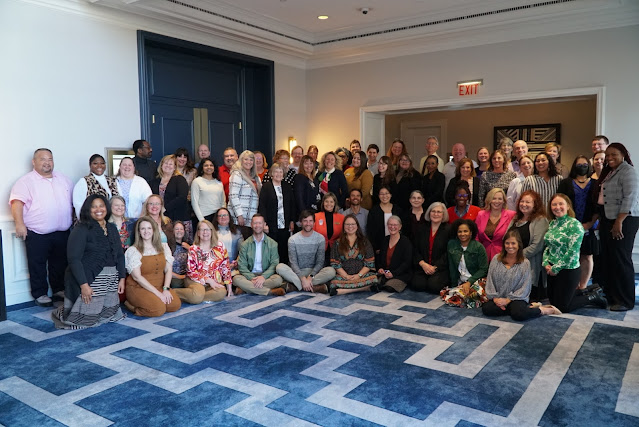
2023 ASSM Annual Meeting Attendees

The day wrapped up with an update on our emeritus members and a group photo. Attendance is pretty strong this year, and I'm going to have a heck of a time identifying all the faces in the photo.

The Struggle to Mend Divides: NCTM Annual Meeting Day 3 and ASSM Annual Meeting Day 1

Today I spent the morning at the NCTM Annual Meeting and then took a detour to check out the National Archives before making my way to Pentagon City for the start of the ASSM Annual Meeting.

Rachel Lambert
I started at 8:00 with Rachel Lambert of the University of California Santa Barbara. This talk shared ideas with her research plenary, but she had a co-presenter, Erica Mason, from the University of Illinois, and the two of them had a full hour to make their case. The overall message is that we (as regular classroom educators, or as systems of educators) too often "other" special education students and prescribe different kinds of instruction, spaces, and expectations for "those kids." Furthermore, some of the reasons we do this are rooted in research, or more specifically, divides in our research communities.

Erica Mason
Mathematics education rarely takes much of an interest in disabled students, but generally, as a field, math ed relies on a broad selection of theories and methods and no one really dominates over the others. Meanwhile, in special education, it's relatively rare to see studies focused on the learning of math, and as a field, special ed researchers use a more limited set of theories and methods. Most are focused on information processing or behaviorist theories and the methodology is almost all quantitative. So not only are we "othering" special education students, we have divides in our academic communities that is creating some "othering" there, too. This has led to some recent fights and misrepresentations of each others' positions and thinking. Rachel offered a critique in this session, specifically focused on some claims made by a group of special education researchers who are using some citations rather recklessly to misrepresent constructivism and teaching that promotes productive struggle.

I then went off to the NCTM Business Meeting. This is maybe my most policy wonkish session choice I make each year, but I like getting an update about the overall health of the Council and to get some insights about things on the horizon. It was another year of NCTM running a deficit budget, and it sounded like a substantial portion of that was due to lower-than-expected attendance at last year's Annual Meeting. (This year's registration figures are much better but still below pre-COVID totals.) NCTM also hired an external diversity consultant to help evaluate and support the Council, and they are discussing affinity groups or a similar structure for members to help increase the sense of belonging people have as members. The last bit of big news concerned the conference next July being co-organized by NCTM and the National Council of Teachers of English. It will be K-5 only, and the program committee intends to offer math-focused, literacy-focused, and math+literacy-focused sessions. It will be held at a hotel with limited space, so something more modest than an Annual Meeting, but it is something they'd like to continue annually.

Julia Aguirre and Karen Mayfield-Ingram
I made my last NCTM session the Iris M. Carl Equity Address, this year given by Julia Aguirre of the University of Washington, Tacoma, and Karen Mayfield-Ingram of the Lawrence Hall of Science, University of California Berkeley. I think this is the first time I've seen this address given by a pair of presenters and it was a wise choice to put two close colleagues together in an almost mini-panel format. Their session focused mostly on structural barriers to equitable math education. Perhaps the dominant barrier continues to be tracking practices. Even at the earliest ages, students are tracked by perceived ability and the effect is a sort of educational apartheid, and anyone who observes these classes and usually tell right away which class is for the "high" kids (where students are often white) and the "low" kids (where students are Black and Brown). So long as our course placements are predictable by demographic factors, we are maintaining inequitable systems and we all know it. The trick is finding the courage and a shared commitment to stop.

At noon, I walked south to the National Archives. Big parts of it were closed for renovations, which was a disappointment, but it's still amazing to think about how I was able to go from my everyday life thinking about inequity in math ed to, about 20 minutes later, standing in front of an original copy of the Magna Carta, which represents a struggle against inequity from another place and another era. It's all part of the same long struggle. I got to see the Declaration, the Constitution, and the Bill of Rights, all of which are quite faded and encased in a lot of protective glass and dim lighting, but ultimately the visit is worth it not because of the items but what they represent.

I caught a train to Pentagon City where the ASSM Annual Meeting is being held. The Friday program was extra light: A one-hour meeting for PAEMST state coordinators, a brief welcome, and then a social gathering. I stepped out early as this kind of social stuff is not for me, and besides, some of us have blog posts to write!

I C U N D C: NCTM Annual Meeting Day 2

Today began with a presentation I really didn't want to miss: Mine! I joined up with Lisa Ashe and Denise Schulz from the North Carolina Department of Public Instruction to deliver a session on advocacy. We talked about governance structures, sources for strengthening your argument, and where to find allies before giving participants about 30 minutes to discuss advocacy strategies in small groups. We had some scenarios for them to consider but they were welcome to bring up their own topics, too. Special thanks to April Pforts, our Iowa colleague, for joining us and helping with the small group facilitation.

W Gary Martin

I next moved to a session from W. Gary Martin and Mariya Rosenhammer from Auburn University. They presented data that they collected about what math is needed for different college majors and the results add to the really strong argument that high school math should include more and better opportunities for students to learn statistics. It was a really solid presentation and the room was near capacity.

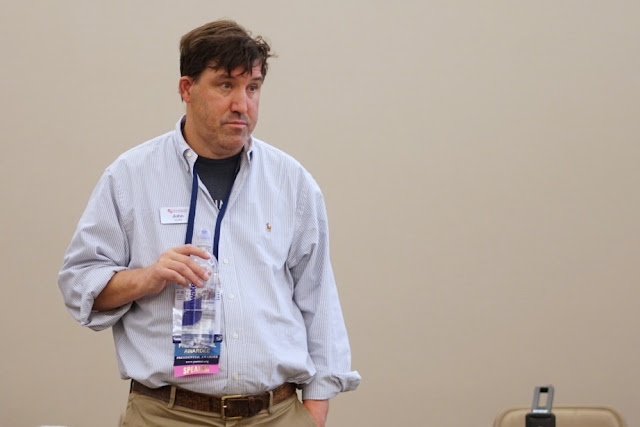
John Seelke

I then caught a 30-minute session by John Seelke, a PAEMST awardee who wished to talk about the current state of discourse in our profession and some ways we can try to remain open to others' ideas. It's awfully easy these days to quickly determine that someone's views might not align with your own and to shut them out before really trying to understand where they are coming from.

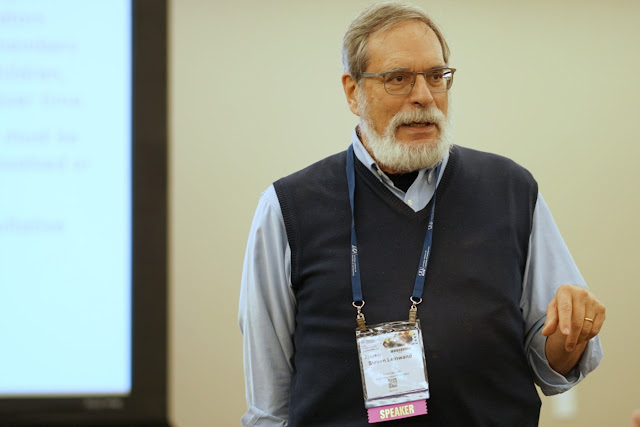
Steve Leinwand

After a great lunch with Ralph Pantozzi (another PAEMST awardee -- so nice to be in good company), I checked in with Steve Leinwand's session about high school math. I suspected it was going to be things I was mostly familiar with, and it was, but it seemed like the right place to be after having a head full of morning ideas and a stomach full of noontime lunch.

From there, I decided to head to the exhibit hall. As someone who isn't in the classroom and who isn't in a position to purchase anything, a lot of what's in the exhibit hall isn't for me. But that doesn't mean there isn't a lot to learn and people to catch up with. I checked in with PhET, who I've always held in high regard since I learned about them and got to know the team while I was in grad school at CU Boulder. I also spent a lot of time at the PAEMST booth, just to talk about the program and some of the work we're collectively doing to keep it going and try to improve it each year. I caught up with Leslie Dietiker, a math educator at Boston University who I was in a working group with years ago at an ISDDE conference. She works with CPM, and visiting their booth is always interesting since those are the texts I began my teaching career with 20 years ago. I moved on and heard about some new work from Math Recovery which might introduce their approaches to elementary math intervention to a larger number of teachers who wouldn't otherwise attend their regular workshops. Lastly, I spent a long time with Cathy Fosnot and Ryan Dent at the New Perspectives booth. I've known of Cathy and her work for a long time now through our shared relationship with the curriculum designers at the Freudenthal Institute and their extension in the U.S. at CU Boulder. We chatted about the state of curriculum development and reviewing and what might be on the horizon and Ryan showed off an innovative approach they're taking to assessment and progress tracking.

This is where the NCTM Annual Meeting becomes more than just a chance to attend sessions and keynotes and browse products in person. It's a chance to talk to people all day long and hear their ideas and ask them your questions and do the same in return. Some of those people are new to me, some I've seen year after year. One moment I'm in the hallway with a teacher from Glenwood Springs whom I've never met, but we have a shared passion for making high school math better, and the next moment I'm chatting with NCTM President Kevin Dykema and he's volunteering to join one of our book study sessions for a book he co-authored. NCTM's not the only place math educators can find a professional community, but it sure can be a good place for it when you spend multiple days in a conference space with other members.

Research and Practice: NCTM Research Conference Day 2 and NCTM Annual Meeting Day 1

Today started at 8 am and I snuck in a little late to see Charles Honensee and Sara Gartland of the University of Delaware present about backward transfer. It's an interesting phenomenon when something students learn later has an impact -- sometimes intentional, sometimes not, and sometimes negative -- on something learned earlier. They reported on a high school quadratics unit that was taught in such a way to improve earlier learning on linear functions, which was a nice result to see.

Sara Gartland

I then went to a series of talks about language and discourse in secondary math. First, a group including Jonathan Foster, Laura Singletary, AnnaMarie Conner, and Hyejin Park (from a variety of universities) described a framework for describing displays. What's a display? It took me a moment to wrap my head around it, but it could be a lot of things, but in most classrooms you're thinking about how teachers and students use whiteboards, Smartboards, posters, and artifacts of student work to display information. I could kind of get a sense for how having a framework to describe these things could help future research studies organize some of their work.

Sarah Roberts

Sarah Roberts of the University of Santa Barbara went next and talked about how to support teachers in including language routines into the curriculum that they develop and find when it isn't there already. With more than 70% of high school teachers reporting that they create their own materials on a nearly daily basis, this kind of work is needed in the secondary grades. The last presentation was from Madeleine Chowdhury from Mesa Community College, and she talked about the role of discourse she's observing in a research study with some of her students.

Madeleine Chowdhury

I went to a research in progress session and heard from some folks from Cal State Sacramento who are working on some quantitative reasoning courses and research to support them. That went well with another researcher at the table, Veronica Cambra-Faraci, who is following up with and learning from former students who took Geometry and Algebra 2 together at the same time in her high school as a way of accelerating to calculus their senior year.

Kyndall Brown

The plenary session was a combination of talks. First, Kyndall Brown from the California Mathematics Project talked about how research informed California's math frameworks.Next, Joleigh Honey from Utah talked about the importance of working across stakeholder groups to affect change in mathematics education. Lastly, and clearly the highlight of the day, was Rachel Lambert from The University of California, Santa Barbara. She's positioned herself and her work at the intersection of special education and mathematics education, and had A LOT of things to say about how these two worlds have traditionally been separated and the impacts it has on how we conduct and interpret research and, more importantly, what it does for the experiences of special education students in mathematics. This talk was well-timed with recent campaigns to come up with a "science of math" that seems to grossly misinterpret research to make claims about teaching all students. The talk wasn't really long enough to work patiently through all the details, but this is an important topic and I hope it encourages more researchers to work beyond those traditional boundaries to find consensus solutions.

In one final session, I joined five people from NC State who are working on a microcredentialing system. As the only participant in the session, I got all the attention I could have wanted, for sure. Sometimes that's just how conference sessions work out.

Jamila Dugan

The NCTM Annual Meeting kicked off with the usual Wednesday night ceremonies, including recognizing the service of the NCTM Board, the program committee, the local hosting affiliates, and honoring the newest NCTM Lifetime Achievement Awardees. This year, that was Joan Ferrini-Mundy and Betty Phillips. I talked about Joan Ferrini-Mundy yesterday, and if you've ever used the Connected Mathematics Project (CMP) materials from Michigan State, then you've benefited directly from Betty Phillips's work. That was followed by the keynote address, delivered by Jamila Dugan, co-author of the book Street Data. She encouraged us to get past "traps and tropes" when talking about equity and listen more to the people and signals closest to our students, and better recognize how it can compliment and make up for the limitations of our larger-scale data collection, such as with state and national testing.

Making Math Education Matter: NCTM Research Conference Day 1, Washington D.C.

It's so good to be back at the NCTM Research Conference! This is one of my favorite conferences: it's a mostly no-frills, just the facts, math ed nerdfest with an amount of academic awkwardness that I find really welcoming.

Abi Leaf, Chair of the NCTM Research Committee

Day 1 of the Research Conference got off to a great start. Our opening session featured Joan Ferrini-Mundy. She's the current President of the University of Maine, a former chief operating officer of the National Science Foundation, a former director at the National Academy of Sciences, and long-time mathematics education researcher. Very few people have held the variety of high-level positions that Joan has, and that helped her craft some perspectives for her opening session.

This talk started in familiar territory, with reminders that it's foolish to think that we'll ever get the "perfect study" that answers our questions about math education once and for all. Joan also noted the flawed logic that researchers need only push out their work in traditional outlets and depend on educators to soak up those ideas and know how to use them. Instead, Joan said, math educators need to use new and varied approaches to research (shout-out to some I've done, like research-practice partnerships and design-based implementation research) and insert themselves in spaces where decisions are made about math education. The rest of the talk went into details about what those spaces look like and the kind of contributions we could make, including spaces for university administrators, state and federal policymakers, assessment and standards developers, funders, higher education STEM faculty, the business sector, and teacher educators.

Joan Ferrini-Mundy

My next session was a panel called "Supporting Elementary Teachers' Mathematics Classroom Discussion Practices." It was good to see the newest work from some researchers I admire and enjoy watching present, and some of what they said had a lot of relevance for me. 

Lynsey Gibbons

First up was Lynsey Gibbons from the University of Delaware. In working with teachers at a couple elementary schools during the pandemic, she noted the need for schools to be true learning spaces -- not just spaces to organize typical learning for students, but spaces for adults to learn, too, as challenges of the pandemic brought about the need to try new and different things, and to do so while considering all the local and not-so-local contexts in which schooling happens. While her study didn't appear to set out to be about Zearn, we heard a lot about Zearn. The schools in her study adopted Zearn as part of a statewide program that gave schools easy and free access, and the schools expected Zearn to be used as part of regular instruction. Some teachers found it frustrating; instead of teaching themselves, they monitored students sitting at computers wearing headphones who were getting taught by videos of teaching. When students got stuck they raised their hand, and then it became the job of the teacher in the room to figure out what had been shown to the student in the videos they'd been shown and then re-teach that content or otherwise get the student back on track. Some teachers quietly (or maybe not-so-quietly) rebelled and switched to using a "regular" classroom curriculum by the year's end.

Annie Garrison-Wilhelm
Next up was Annie Garrison-Wilhelm, now faculty at Washington State University. She looked at what could be learned about improving math teaching by examining teaching practices across multiple content areas, and how that shaped what she called "a vision for dialogic disciplinary discussion." One of her results was that teachers tended to make a stronger case for preparing students to engage in the disciplinary community in math and science than they do when teaching literacy, which seems like a good thing for math.

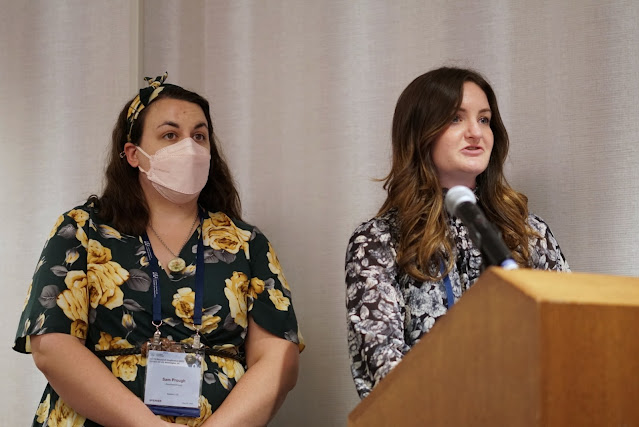
Sam Prough and Rebecca Memmolo
Sam Prough and Rebecca Memmolo from the University of Delaware continued this theme of looking across content areas. Their research identified some struggles, like when teachers or school administrators see math as not something that requires debate and discussion since there's only "one right answer" to elementary math problems.

Temple Walkowiak
Temple Walkowiak from NC State served as the discussant and brought some of the ideas together across the sessions. There was a lot to think about here, and Lynsey's thinking at the beginning about local and beyond-local context reminded me about the role I play to normalize some positive practices and perceptions about math education and the need to work across disciplines to help elementary teachers make sense of the practices that work best in different content areas.

Robert Krakehl
I checked into a "research in progress" session where we sat at roundables with researchers in the midst of figuring out their latest work. I enjoyed hearing from two researchers from Amplify, Heather West and Sandra Pappas, who are developing screeners and diagnostic assessment tools for K-8 mathematics. We're doing some similar work in Colorado and it's good to know we're not alone. I then moved rooms and caught the end of Robert Krakehl's session about AP Mathematics Enrollment and Performance. In short, AP tests consistently favor White and Asian students. This wasn't new news, and it's wasn't Robert's talk to try to explain all the reasons why. Instead, he focused on making sense of the data, and one thing we did observe was that the Calculus BC exam has significantly higher pass rates across the board when compared to Calculus AB and AP Statistics. Perhaps it's a self-selection issue, where only the best-prepared students are encouraged to take it.

Pat Herbst
Next was a panel comparing innovative models for mathematics teacher learning. Pat Herbst from Michigan started off with what he's learning from their StoryCircles project, which uses cartoon-like classroom simulations to develop teacher thinking and decision-making skills.

Hilda Borko
Next up was Hilda Borko of Stanford, who reflected on two different teacher learning models that she's helped establish, the problem-solving cycle and the teacher leadership preparation model. These have been developed in research-practice partnerships and make use of classroom video to generate discussion and reflection on teaching practice.

Hollylynn Lee
Hollylynn Lee from NC State is working on online professional development models for statistics and data science as part of their instepwithdata.org initiative.

Gil Schwarts

The discussant for this session was Gil Schwarts from the University of Michigan. She helped us think about these teacher learning programs as either content-oriented or process-oriented, as well as adaptive or specified, and how goals and tensions of each project are served by their different designs.

Whew! If that wasn't enough, the day ended with a poster session. If you remember social distancing from the pandemic, this was certainly not that. We were all crammed into a too-small and too-noisy space but I got a few things from the posters I visited. My highlight was probably meeting Jinfa Cai. He was the editor of JRME and NCTM's research compendium, and I have a lot of admiration for people who can take on those kinds of big editing projects.


Why We Do What We Do: NCTM Day 4, Los Angeles

Data science panel with Mahmoud Harding on the microphone

I needed to sleep in a little and then pack my bags and check out of my hotel, so I didn't get to the convention center until the second set of sessions. I headed for a panel presentation about data science but missed the introductions. The program book said the speakers were Anna Bargagliotti, Mahmoud Harding, Hollylynne Lee, and Susan Peters, but I think that lineup might have changed. I've been in a lot of data science discussions over the past year so I'm not sure how much of this was new to me, but the Q&A revealed to me that there are a growing number of resources out there that a lot of people simply don't know about. (Note: datascience4all.org is a good place to start.) We really are still in the early stages of this, as was evidenced by one panelist explaining that he teaches in one of the largest districts in California, with 200 math teachers across 12 high schools, and he's the only one teaching a data science course.

Megan Burton

I've never been to the AMTE conference (that's the Association for Mathematics Teacher Educators) but I occasionally attend an AMTE-focused session at the NCTM or NCSM conference. I do that partly for the information, but partly to figure out if I have a place in that organization. As a math specialist in a state department of education, part of my role involves providing professional development to teachers and I occasionally get to work with licensure and endorsement policies for teachers. But unlike most (all?) of AMTE's members, I'm not a higher education faculty member charged with the education of preservice teachers. This session, led by Megan Burton, was titled "Mentoring, Challenging, and Empowering: AMTE's Standards for Preparing Teachers of Mathematics." I think I would have liked hearing about the standards, but the first half focused on mentoring and that's not an aspect of my job and therefore wasn't as relevant to me.

I might have stayed in the AMTE session until then end, but I wanted to catch a 30-minute session called "Creating and Sustaining a Free Mathematics Conference to Empower Educators." It was led by Cody Osterhout and Paul Volkert, two educators in a New York BOCES (bureau of cooperative educational services) who creeated a math conference with very simple and humble beginnings and have grown it over the past five years. I'm fortunate that our state math conference is well-established, but I wanted that 30 minutes to look at conferences through a fresh set of eyes and to consider what's essential and what's extra as we adjust our conference to meet changing needs and varying levels of participation.

José Vilson

I somehow made it all week without hearing about anyone who couldn't participate in the conference due to COVID, and then Eugenia Cheng, our closing speaker, had to cancel on short notice because she got COVID! I'm sure she wasn't the only one, but it was probably too much to hope for that nobody would get sick all week. So that left the program committee in a bind -- what can you do to replace a keynote speaker with about 48 hours notice? You take advantage of having José Vilson on your program committee, that's what. José's an experienced keynote speaker with experience on the big stage at NCTM, having delivered the Iris Carl address in 2019. He wasn't the most prepared, or dressed like he might have for a keynote, but he quickly put together a talk called "A Moment of Hope: Why We Do What We Do." The talked moved a bit like a series of Ignite sessions, with maybe 5-minute chapters highlighting different reasons for teaching and working with youth. Perhaps the most impactful was José's collage of photos of former students of his who have gone on to become teachers.

So long, L.A., and thanks for the bikes

The final bit of business to conclude the 2022 Annual Meeting was for Trena Wilkerson to hand over the presidency of NCTM to Kevin Dykema. Kevin is a middle school teacher from Michigan and has long been involved as an NCTM board member and as a member of various committees. It's always nice to see a teacher lead an organization of teachers, and I have a sense that Kevin is going to do great. There will be a lot of NCTM activities in the meantime, but next year's conference is set for Washington, D.C. We were there in 2018, which really wasn't long ago, but it's a great place for the conference because the population density is high and that helps improve turnout. I like visiting D.C., and there are still a ton of museums and cultural attractions I want to see, so I'm looking forward to it already.

From Business to Baseball: NCTM Day 3, Los Angeles

Trena Wilkerson (on her last full day as NCTM President!)

I started my day at the NCTM business meeting. I wouldn't recommend that most people go to the business meeting, but for the few of us who like getting an update on the health and direction of NCTM, it's the place to be. It's unfortunate to see that NCTM's budget finished in the red, again, but given how rough it's been with events and the pandemic, things could have been much worse. Membership stands at about 29,000, with about half of those opting for the essential membership tier.

Nicole Joseph

Next I went to the Iris Carl Address. This year's speaker was Nicole Joseph of Vanderbilt University, and she had a very well-prepared talk to help us confront some of the inequities and biases faced by Black girls. At the end, I noted that she charged her fellow researchers to push to do large-scale, quantitative research studies. She explained that while we've learned a great deal from the many small-sample, qualitative studies, if research is going to affect policy, state and national decision-makers are going to want big studies with some statistical power. I'm really not doing the session justice with my brief summary, so be thankful that this is one of the sessions that NCTM records and makes available to watch after the conference.

At noon I met up with my co-presenters, Fred Peck and David Webb. David was our advisor at CU Boulder and we've established this wonderful tradition of presenting together each year at NCTM. This was the first time we've seen each other since the San Diego conference in the spring of 2019, so we did a little bit of prep and lots of catching up with each other. Our 2:45 session, "Making Meaning of Systems of Equations with Contexts and Representations," went very well. We've done versions of this one before, and each time we seem to get a bit better at it. We had a good audience, but had room for more, and I think those in attendance got a lot out of it.

W. Gary Martin and Jean Lee

David and I caught the last 20 minutes or so of a late session called "We Need More Math Teachers! Changing the Narrative About Mathematics Teaching as a Career." Jean Lee and Gary Martin were the lead speakers for the session, and just with the bits we saw it was really useful. Essentially, they're involved in an effort to share positive things about being a teacher. And it's not just their opinion -- this is part of a broader project that has collected data and surveyed teachers and when you look at the data, the salaries, working conditions, and retirement benefits are more favorable than the news headlines might lead you to believe. I'll have to check out the materials later, and connect with some of the Colorado folks who are involved in the research.

It's time for Dodger baseball!

Finally, I got really adventurous with the Metro bike share system and pedaled up to Dodger Stadium to see the Dodgers play the Rockies. The bike ride was probably more memorable than the game, as the Dodgers had a 9-0 lead by the time I left during the 7th inning stretch. Afterwards, I biked all the way back to USC, which is about a 6 mile trip. Add that on top of an almost 17,000-step day, and I'm pretty beat. But just one half day left of #NCTMLA22, and then I can rest!

"It warms my heart": NCTM Day 2, Los Angeles

Kristen Faust

Today was Day 2 of the NCTM Annual Meeting and it was a very full day for me. I began in a session called "Opening Math Pathways to Each Student: Our Journey From One School to District Wide," led by Kristen Faust, Tracy Fischer, and Mary Richards of North Clackamas School District, Oregon. I'm seeking out these district-level stories about pathway reforms to better understand the challenges involved and get some insights from those doing this work. This group is four or five years into this process, and they've moved their middle schools towards more students in heterogeneous classes that are taught to grade level standards. Although the pandemic hurt them in a lot of ways, one way it helped is that it disrupted their traditional district tests that were used to determine middle school math course placement. So with no test, there was no placement, and no need to label some students as not worthy of grade-level work.

Mary Richards

Following that session I caught up with Fred Peck, my old CU Boulder grad school colleague who is now on the faculty at the University of Montana. We're co-presenting Friday and this was a good time to do some catching up and to work on our slides. The presentation is in pretty good shape, and it's a relief to know I won't have any late-night slide deck designing to cost me more sleep. Today was my 7th day in a row of these conferences, and it's tiring enough just sticking to a typical participant schedule.

By chance, I ended up having lunch with Sara VanDerWerf. Sara and I have connected in passing a few times over the years, but now that we're both math specialists in state departments of education we have a whole lot more to talk about. And talk we did! There are aspects of our work in state government that sometimes require some tricky navigation, and even though Sara has only been in the job for less than a year, she was describing things with some of the same language that I find myself using.

Ginny Stuckey

After lunch, I met up with Fred and we headed to "Expanding the Frontiers of Math Class," which was to be led by Karim Ani of Citizen Math. Karim led a great session at the 2019 ASSM Annual Meeting, and I was looking forward to seeing him again. Unfortunately, he had a change of plans and Ginny Stuckey filled in as his substitute. She was great! She also works for Citizen Math, and it made me glad that I didn't change my mind and opt to attend something else. Ginny gave us some decent, but somewhat ordinary examples of math tasks that use a problem solving context but keep the focus on the math. Then she contrasted that to a problem solving context where the focus stays on solving the problem, and the math is just a tool. The metaphor she used as looking at a telescope (some of which are quite beautiful!) versus looking with a telescope, which is ultimately what the telescope is really for.

Mark Russo

From there, I headed to another storytelling session about a district trying to reform math teaching and learning. Mark Russo works in a suburban school district in New Jersey and his session was called, "Catalyzing Change When Change is Hard." For me, I knew the "catalyzing change" in the title referred to the NCTM book series by that name, but it was a little delight of the day to hear several first-time attendees say that they knew nothing about the book, and were there simply because the title and description of the session drew them in. The highlight for me was being seated next to a high school teacher from Arizona, and the conversations we had during the turn-and-talk moments. She's in a school where most of the math department is just fine leaving things as-is, and she attended the talk to develop some greater powers of persuasion that she might use to get a reform movement going in her school. Oh, as a bonus, I think Mark Russo had the quote of the day, and it was something he said before the session even started: "I've heard more I do, we do, you do-bashing in one day at this conference than I've heard anywhere, and it warms my heart."

The next session I went to wasn't initially on my list, but I couldn't resist "Modeling as Storytelling: Developing Mathematical Identities With Students on the Margins of Algebra" by Kara Imm. Kara is part of the extended group of us who has ideas rooted in Realistic Mathematics Education. I'm connected through David Webb and the Freudenthal Institute US, while Kara is connected through Cathy Fosnot and Math in the City. Anyway, Kara's presentation was about a project that is stretching her beyond her RME roots. The title itself explains a lot, and like the previous session, Kara's generous use of turn-and-talks gave me ample opportunities to discuss issues of mathematical modeling and student identity with some of the other conference-goers nearby.

Zalman Usiskin

And finally, to wrap up the day, I went to "Circling Through a Century of NCTM: A Celebration Sprinkled With Music" with Zalman Usiskin. Zal has been presenting at NCTM for about 50 years now, and I couldn't think of anyone better to give a historical perspective of the organization. This talk was originally supposed to happen at the centennial meeting in Chicago in March of 2020, but that event was cancelled. Thankfully, the program committee and others encouraged Zal to deliver it now, more than two years later. Little did I know, but Zal is quite musical and has performed some songs he's written about math at select events in the past. He plays the piano, too, but tonight he had his cousin play who happens to be a world-class pianist. The history was rich and the song were often humorous, and as a lover of math education history it was time well spent for me. I wish I could sit with Zal for about a month and pick his brain about math ed history.

St. Vincent de Paul, which I pass on the way to my hotel

After all that, I grabbed an ebike from the Metro bike share system and made it back to the hotel. See, I told you it was a full day! And tomorrow will be, too. On top of my own presentation, there's the Iris Carl address, the NCTM business meeting, and a few other sessions on my schedule. But that's how these things go -- there's so much to see and do!

One Mathematics, Many Voices: NCTM Day 1, Los Angeles

Getting set for the big opening

Today was the first day of the Annual Meeting of the National Council of Teachers of Mathematics in Los Angeles. But before I made the long, long bus ride from Anaheim to L.A., I took in a couple extra sessions at NCSM.

Peter Liljedahl

I missed Peter Liljedahl's session yesterday when it filled up and they shut the doors, but he was kind enough to stick around through this morning and offer the same session again. Now that I've seen his talk, it's understandable why he's such a hit: he built up a solid research program, got some nice findings, he wrote some teacher-friendly books, and he's gotten lots of practice delivering his talk. It's an exceptionally strong bit of work. I was particularly persuaded by his bit on mimicry. I've been asked by math specialists how they can get teachers to stop relying on, "I do, we do, you do" as their instructional model. Sometimes we see this in elementary, where some reading programs promote that model as a form of effective instruction. I'm no authority on how well it works in other content areas, but it's not great for math, and Peter gave the most powerful articulation of why it's so inadequate. He says that when you use an "I do, we do, you do" model, what students are doing is mimicking, not learning. Mimicking can work for you in the short term, but not in the long term. In mathematics, students' luck with mimicking tends to run out by the time they're in Algebra 1, when they really need to be thinking and problem solving for themselves if they're going to be successful. I ordered Peter's books while sitting in the session and I'll be eager to dig into them when I get home.

Caity Larson

I stuck around for one more session, this time to hear a story about math reforms spurred on by Catalyzing Change. Caity Larson and Catherine Castillo were math specialists in Springfield, Missouri, who carried out a multi-year plan to reform curriculum and instruction in their schools. They were often met with resistance, but they steadily won over teachers and other stakeholders. But when it was time for all that work to pay off, district leadership put a halt to it. There were certainly positives in the session, but it also served as a cautionary tale. You'd never know it talking to people at the conference, but there really are people out there who don't want math teaching to change.

NCTM President Trena Wilkerson

After the bus ride from Anaheim to Los Angeles, I settled in at my third hotel of the week and then made my way to the convention center for the NCTM Annual Meeting. The first person I met was from Hawaii. And so was the second and third. Then there were more. Hawaiians are here in force! After some time cruising the exhibit floor, I headed to the opening session. There were lots of preliminaries to wait through, but I've found that those parts get better every year as you get to know more of the people and develop a greater appreciation for the work they do. Part of what lengthened it was that it was the first in-person annual meeting in more than three years, so they did things like take extra time to recognize previous lifetime achievement award recipients that we didn't get to celebrate during the pandemic. It was great seeing Elizabeth Fennema on the big screen!

Chip Heath

The keynote speaker was Chip Heath, a professor and author who wrote a book called Making Numbers Count. It wasn't a math education talk, really. It was more of a collection of interesting and educational anecdotes that illustrated the way we see numbers and how numbers help us make sense of our worlds. In particular, there were good examples of things where we don't have great sense when it comes to numbers, whether it's because the numbers are very large or because the numbers haven't been rounded to something memorable. Malcolm Gladwell was the opening keynote speaker when I attended my first NCTM Annual Meeting in 2008, and this felt a lot like that. I'm not sure it was the best possible representation of the conference theme, One Mathematics, Many Voices: Sharing Our Collective Stories of Rehumanizing Mathematics Teaching and Learning, but as a stand-alone keynote it had its own reasons to be engaging.